PREDECESSORS AND SHORT HISTORY: This
branch/clan of the Tarin tribe (#3) came
from Tarin Kot in Qandahar,
Afghanistan
during Durrani rule circa 1752. The chief at that time was the uncle of
King Ahmad Shah Durrani and he led a flank of Afghan cavalry (Risalah)
in the Third Battle of Panipat in 1761, in which the Marathas were
defeated
comprehensively. Later he was give the title of Sher Khan and
the
lands that he held for the Afghan Kingdom as Subedar previously, were
thereafter
conferred on him as a personal and semi-independant territory. In 1888,
after the death of Nawab Bahadur Sadar Muhammad Habib Khan
Tarin, Risaldar and Chief of Dheri and Talokar, the Tarin Sardari was
formally abolished by Punjab Government, due to the unreliabilty of
competing heirs. By a decision of the ruling government in April 1889,
Dheri and Talokar jagir was
split up, with Talokar (also refered to as Talokar Khangi
Jagir) given to the
family head as well as some additional land and shares in a further
eight or nine villages, the sons of Habib Khan were placed under Court
of Wards by
the government and in due course, inherited this jagir. After
independence
most of the family's property was forcibly seized during the Ayub
regime
in the 1960s. The family today is noted for its very active public and
social traditions which were set in place by Khan Abdel Salim Khan, and
continued by his descendants. Estate holders were...
- Sardar BOSTAN KHAN Sher
Khan, Sardar of Tor Tarin,
- Sardar NADIR KHAN
[Malik Darwesh], Sardar of Tor Tarin,
- Sardar ILYAS KHAN
[Malik Ilyas], Sardar of Tor Tarin,
- Sardar GADAI KHAN,
Sardar of Tor Tarin,
- Sardar AMEER KHAN,
Sardar of Tor Tarin, married and had issue, two sons.
- Sardar Najibullah Khan (qv)
- Sardar Rowhilla Khan, Rais of
Talokar, he was based at Talokar, and made clan war chief, married and
had issue. He died in 1807.
- generation
- Sardar Karam Khan, Rais of
Talokar and clan war chief, married and had issue.
- Nawab Sardar Habib Khan Bahadur (qv)
- Sardar NAJIBULLAH KHAN,
Sardar of Tor Tarin, Khan of
Dheri -/1804, he was based at Dheri and was Hakim-i-Hazara and
overall Sardar and chief till his death. He died 1804.
- Sardar MUHAMMAD KHAN,
Sardar of Tor Tarin, Khan of
Dheri. He died sp.
- Sardar GHULAM AHMED KHAN,
Sardar of Tor Tarin, Khan of
Dheri -/1850, he schemed against British
interests during the Second Sikh War of 1848/1849 and was eventually
arrested in May 1849 on the orders of Major James Abbott, the first
British administrator/District Commissioner of the Hazara area, who
removed him and many Tarin adherents and chieftains from their offices
and estates, and was sent to Allahabad prison, where he was sentenced
to 10 years hard labour in October that same year; there in 1857, while
still imprisoned, he tried to instigate a prison uprising against the
British authorities and was summarily executed, married. He was hanged
in
Allahabad prison sp in 1857.
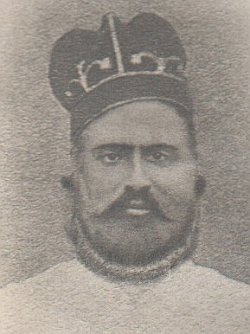 Nawab Sardar HABIB KHAN
Bahadur, Sardar of Tor Tarin, Nawab of
Dheri
and Rais of
Talokar
1850/1888, Hakim-i-Hazara,
Risaldar, born 1830 in a collateral branch of the family (#2),
after being selected Chief of the Tarins, he met Brevet Lt.-Colonel
Robert Cornelius Napier in 1851, who was engaged with the extension of
several military roads into the Indus and the nearby Attock area of the
Punjab; a mutual regard developed between the soldier and the chief and
Sardar Habib Khan
subsequently carried out several important commissions for Napier; in
February 1852, Sir Henry Lawrence the Punjab Resident visited the
Hazara, and it was
through Napier’s intercession that Habib Khan and a number of other
chiefs were able to obtain a general amnesty and return to their homes
and resume their estates; he served as a native cavalry officer
Risaldar in several campaigns in
the Punjab hills and the Frontier/Hazara area, and later as far as
Bengal, Bihar
and Bhutan between 1852 and 1863; shortly afterwards in the same
year, 1863, he helped set up a silk-manufacturing factory in Sri Nagar,
Kashmir State, on the request of Maharaja Ranbir Singh, on completion
of the project he returned home and thereafter was engaged in extensive
litigation with relatives and
others, as well as the Punjab Government regarding some property; in
1868-69, when the British were making their new Permanent
Revenue Settlement for the Hazara area (completed in 1872), he objected
to the reduction of his property in favour of some other chiefs and
then rebelled against the newly instituted British Government from 1869
to 1878;
he was
caught, and was briefly confined at Attock, Punjab, before being
released on parole, in 1884 on the direct intervention of Lord Napier
of Magdala, and thereafter he remained engaged in
litigation against the Government for the last years of his life, and
did manage to get some of his claims back; he was also granted various
belated honours by the Government of India,
including the personal title of Nawab Bahadur, additional jagir grants
and revenues and an annual Jangi Inam (war award/allowance), he had
also been given special powers as J.P. and area magistrate in Hazara in
1872; he married 1stly, (his
cousin) Ashraf
Khanam, a Tarin Afghan lady, married 2ndly, Nur Shah
Begum, an Afghan, Barakzai Durrani lady, married 3rdly, Khair
Bibi Khanam, a Yusufzai Pathan lady, and had issue. He
died in December 1888. Nawab Sardar HABIB KHAN
Bahadur, Sardar of Tor Tarin, Nawab of
Dheri
and Rais of
Talokar
1850/1888, Hakim-i-Hazara,
Risaldar, born 1830 in a collateral branch of the family (#2),
after being selected Chief of the Tarins, he met Brevet Lt.-Colonel
Robert Cornelius Napier in 1851, who was engaged with the extension of
several military roads into the Indus and the nearby Attock area of the
Punjab; a mutual regard developed between the soldier and the chief and
Sardar Habib Khan
subsequently carried out several important commissions for Napier; in
February 1852, Sir Henry Lawrence the Punjab Resident visited the
Hazara, and it was
through Napier’s intercession that Habib Khan and a number of other
chiefs were able to obtain a general amnesty and return to their homes
and resume their estates; he served as a native cavalry officer
Risaldar in several campaigns in
the Punjab hills and the Frontier/Hazara area, and later as far as
Bengal, Bihar
and Bhutan between 1852 and 1863; shortly afterwards in the same
year, 1863, he helped set up a silk-manufacturing factory in Sri Nagar,
Kashmir State, on the request of Maharaja Ranbir Singh, on completion
of the project he returned home and thereafter was engaged in extensive
litigation with relatives and
others, as well as the Punjab Government regarding some property; in
1868-69, when the British were making their new Permanent
Revenue Settlement for the Hazara area (completed in 1872), he objected
to the reduction of his property in favour of some other chiefs and
then rebelled against the newly instituted British Government from 1869
to 1878;
he was
caught, and was briefly confined at Attock, Punjab, before being
released on parole, in 1884 on the direct intervention of Lord Napier
of Magdala, and thereafter he remained engaged in
litigation against the Government for the last years of his life, and
did manage to get some of his claims back; he was also granted various
belated honours by the Government of India,
including the personal title of Nawab Bahadur, additional jagir grants
and revenues and an annual Jangi Inam (war award/allowance), he had
also been given special powers as J.P. and area magistrate in Hazara in
1872; he married 1stly, (his
cousin) Ashraf
Khanam, a Tarin Afghan lady, married 2ndly, Nur Shah
Begum, an Afghan, Barakzai Durrani lady, married 3rdly, Khair
Bibi Khanam, a Yusufzai Pathan lady, and had issue. He
died in December 1888.
- Khanzada Abdel Aziz Khan (by Ashraf Khanam), died sp.
- Khan Abdel Majid Khan (by Nur Shah Begum) (qv)
- Jemadar Khanzada Abdel Latif Khan, he served in the
Punjab Regiment with the
British Army
and died in Mesopotamia, in World War I (1917), and received a
posthumous I.D.S.M. (Indian Distinguished Services Medal); married and
had issue, one daughter. He died 1917.
- Khanzada Abdel Rahim Khan, married Rahmat Jehan Begum,
and had issue, two sons. He died in 1957 or 1958.
- Khanzada Amin Khan (by Rahmat Jehan Begum), married
Mariam Begum, and has issue, two sons and one daughter.
- Shireen Khan
- Miskeen Khan
- Nasreen Bibi
- Khanzada Ibrahim Khan (by Rahmat Jehan Begum), born
1941, educated at the local
High School, landed proprietor of his share in the ancestral property
of village Talokar, Haripur, Hazara, NWFP; married in Haripur, Hazara,
NWFP (now KP), and has issue, one son and one daughter.
- Khanzada Muhammad Yousaf Khan Tareen, married and has
issue, four sons.
- Fazal Kareem Khan, who is a landlord and is
involved in agriculture business in Haripur, Pakistan.
- Fazal Rahim Khan, who is serving as Mechanical
Engineer at Arabian Cement, Saudi Arabia.
- Muhammad Ali Khan, who is a business man in
Bordeaux, France.
- Muhammad Ashraf Khan, who is serving as
Verification Engineer at Ericsson AB, Sweden.
- Taj Begum
- Khan ABDEL MAJID KHAN
O.B.E., Khan of Talokar (Khangi Jagir) 1888/1939,
born
1877, he was made a
ward
of the government under the Court of Wards until he attained his
majority; educated privately under
English tutors and later
qualified
as a Barrister from Inns of Court, London; he served as a Senior
Magistrate,
Sessions Judge and M.L.A. for his area, married and had issue, three
sons. He died
September 1939.
- Khan Sahib Abdel Salim Khan (qv)
- Khanzada Abdul Hamid Khan, married 1stly, Sultana Khanam
a Tarin lady, married 2ndly, 2nd November 1961, Ms. Hala
Zarin Hamid Khan, a Punjabi Jat lady from Lahore, and had issue, five
sons.
- Hafiez Khan (by Sultana Khanam), died young sp.
- Waheed Khan (by Sultana Khanam), died young sp.
- Abdul Mujeeb Khan (by Hala
Zarin), born 14th September 1963 in
Abbottabad, NWFP, Pakistan; graduated with a Bachelor's Degree in Law,
presently (2010) working as a banker at the
Bank of
Punjab, Government of Punjab, Pakistan; married 5th May 1993 in Lahore,
and has issue. (Village Talokar, Haripur, Hazara,
NWFP, Pakistan)
- Miss Aghana Khan
- Miss Iza Khan
- Abdul Haseeb Khan (by Hala
Zarin), born 28th February 1964 in Lahore,
Punjab, Pakistan; educated at the University of Glasgow (Masters of Law
and Legislative), presently (2010) working at the Ministry of
Privatization Commission, Government of Pakistan as a Senior Legal
Consultant; married 4th August 2003 in Karachi, Sindh, and has issue. (Village
Talokar, Haripur, Hazara,
NWFP, Pakistan)
- Abdul Wasey Khan
- Abdul Dayan Khan
- Abdul Naghib Khan (by Hala
Zarin), born 15th June 1968 in Abbottabad,
NWFP, Pakistan; graduated with an M.Sc. (Agricultural Economics),
presently (2010) working in Iraq at
ACDI/VOCA for USAID/Iraq Commuinty
Action Programme as Director, Marla Ruzicka Iraqi War
Victims Fund; married 7th July 2005, Amna Naghib Khan, and has
issue. (Village
Talokar, Haripur, Hazara,
NWFP, Pakistan)
- Abdul Aaleem Khan
- Abdul Tahmeed Khan
- Col. Khanzada Abdul Rashid Khan, he served with 5th
Cavalry,
Pakistan Army; married and had issue, one son. He died 1969.
- Khan Sahib ABDEL SALIM KHAN,
Khan of Talokar (Khangi Jagir) 1939/1957, born 1907, a
progressive thinker, he understood that a major change was afoot and
he changed the family’s role accordingly, he believed that service,
i.e. public service, was where
old families had a role to play in modern Pakistan. He himself served
as Pakistan’s High Commissioner/Ambassador in several countries,
including Afghanistan, Ceylon (Sri Lanka, Pakistan's first Ambassador
there),
Japan (he set up the Pakistan embassy there) and, as his last posting
at the time of his death, Deputy High Commissioner in Britain (1957).
He also undertook a number of charitable initiatives in his native
area, including setting up a Boys School (primary to high school to
serve 5 villages), a vocational college for men, two wards in the
district hospital and also, a well-known agricultural research station
for the development and improvement of farming and livestock; he
married
Mahmooda Salim Khan, born in May 1913, died in June 2007 at Abbottabad,
daughter of Capt. Sardar Sir
Sikandar Hayat Khan, K.C.S.I. of the Wah
family, and his first wife,
Zubaida Khatun, and had issue, two
sons. He died 1957.
- Khanzada Zahid Salim Khan, born March 1937, overlooked in
the succession; married Mrs. Anne Morrison
of Virginia, U.S.A., and had issue, three sons and one daughter. He
died 2002.
- Christopher Salim Khan (U.S.A.)
- Robert Salim Khan (U.S.A.)
- Timothy Salim Khan (U.S.A.)
- Elizabeth Salim Khan [Mrs. Elizabeth Whitney-Flew],
presently working with the Asia Foundation, and also running several
small charitable concerns in the Northern Areas of Pakistan and Kashmir
with her husband; married Mr. B. Flew. (Pakistan)
- Khan Sahib Javed Salim Khan (qv)
- Khan Sahib JAVED SALIM KHAN
C.S.P., Khan of Talokar (Khangi Jagir) 1957/1979, born January
1939, educated
at the University of Cambridge, U.K. (Ph.D. Economics); Secretary of
the Frontier Provincial Planning Department, the Federal (Pakistan)
Planning Commission, the Pakistan Agricultural Development Board, and
Pakistan’s Representative to the F.A.O., Rome, Italy, and received
awards for his services there. He married Mrs. S. Javed Salim Khan,
born 1946, a prominent social worker of the area, and an M.P.
1988/1993; daughter of Brig. Sardar Azmat Hayat Khan of the Wah family;
and had
issue, three sons. He died 1979 in Rome (#1).
- Khanzada Prof. Dr. Omer Salim Khan, born 10th March 1965,
assists in
running
various family charities and is also managing a small research centre;
married to the third daughter of Khan Muhammad Bakhtyar Khan of
Mathana,
Tanoli in Lassan Tanawal area of Amb state, a cousin of the present
Nawab Salahuddin Saeed Khan of Amb. (Abbottabad,
Pakistan)
- Khanzada Usman Salim Khan, born March 1969 in Lahore,
educated at
the National College of Arts (B.F.A.); Pakistan CEO, Messrs Impact
Design , Islamabad, Pakistan, which is one of the
top design firms in the country; Member, Pakistan Association of
Designers & Design Consultants; married Syeda Bokhari of a Lahore
Syed family, and has issue, two sons. (Islamabad, Pakistan)
- Master Hussain Salim Khan
- Master Zain Salim Khan
- Khanzada Abid Salim Khan Tarin, born 11th November 1971,
married
(div.) 2002 in Islamabad, educated with HSBA - Business Management
(Punjab); presently (2011) operating a pharmaceuticals-related business
in Lahore, Pakistan; he is a well-reputed equestrian and polo player of
international standing; Member of the Executive, Equestrian Federation
of Pakistan; Manager, Pakistan National Tent-Pegging Team, 2004/2009,
which won several medals in Oman, Jordan, UAE, South Africa and Yemen;
and has issue, one daughter and one son. (Lahore, Pakistan)
- Miss Naimal Khan
- Master Haider Salim Khan
The help of Dr. Omer Salim Khan is gratefully
acknowledged, July 2008.
The help of Sophia Duvenant, is gratefully acknowledged,
21st September 2005 and December 2010.
The help of Ilyas Khan, is gratefully
acknowledged,
January 2011.
|